

The Two-Headed Dragon
If you are a Christian in America, you have more evangelism opportunities than you know what to do with. Walk out your front door, and you are almost guaranteed to bump into one of two people.
A secular atheist.
A progressive Christian.
The Pew numbers1 break down roughly like this:
~29% are “Nones” — atheist, agnostic, or “no religion in particular.”
~62% call themselves “Christian.”
Wait, 62% Christian? So what’s the actual problem?
Take a look around. If 62% of this country were actually born-again, Holy Spirit-indwelt Christians, America would not look like what it does.
That 62% number is a costume. A massive slice of it is progressive, seeker-sensitive, feelings-first church attendance that has never met the God of the Bible. Pew itself reports that around a third of self-identified “Christians” reject or doubt the existence of Hell, and roughly half believe there are many paths to eternal life outside of Christ.
The degree of progressiveness varies, of course, but they all point in the same direction. The real landscape is not “one faithful majority and a small minority of skeptics.” It is two buckets that look different on the outside and are increasingly identical on the inside: the explicitly secular, and the Christ-named but functionally secular.
These two groups are not separate. They are one enemy wearing two different costumes. The atheist and the progressive Christian are bowing at the same altar. They just draped different robes over the statue.
That altar has a name.
Humanism.
What Humanism Actually Is
The American Humanist Association defines humanism as:
“a progressive philosophy of life that, without theism or other supernatural beliefs, affirms our ability and responsibility to lead ethical lives of personal fulfillment that aspire to the greater good”2
Translation?
“We don’t need God to tell us how to live. We’ll figure it out ourselves.”
That’s humanism. It is the belief that man is the measure of all things. Man determines truth. Man determines morality. Man determines meaning. Man determines destiny.
R.J. Rushdoony called it “the religion of fallen man.”3 He was exactly right. It is a religion. It has its own creed, its own priests, its own scriptures, its own salvation plan (human progress through education, science, government, therapy, activism), and its own eschatology (utopia on earth).
Dr. Henry Morris put it this way:
“Mankind’s greatest and most basic sin has always been that of seeking to replace God with man.”4
That’s the sin. That’s the root. Every version of humanism is a different delivery system for the same drug.
Humanism is also not a niche movement. It is the philosophical architecture undergirding America’s dominant cultural establishment. Public schools. News media. Courts. Politics on both sides of the aisle. Huge swaths of what we call “the church.”
The First Humanist Manifesto Was Written in Eden
Humanism started in a garden. With a serpent. And a question.
“Did God actually say...”
Genesis 3:1
That is where humanism was born. The original pitch went like this:
“You will not surely die. For God knows that when you eat of it your eyes will be opened, and you will be like God, knowing good and evil.”
Genesis 3:4-5
The first humanist manifesto. Written by the devil himself.
You don’t need God. You can be God. You can decide for yourself what is good and what is evil. You can be your own authority.
Eve took the bait. Adam took the bait. And every human being born since has inherited the same rebellious heart that says, “I will determine what is true. I will be the measure.”
When the American Humanist Association publishes a manifesto declaring that “no deity will save us; we must save ourselves,”5 they are not saying anything new. They are echoing the oldest lie in human history. They just put it on a letterhead.
The Devil was the first humanist - everyone since has been plagiarizing.
The Five Pillars of the Humanist Religion
Every flavor of humanism is built on the same five pillars.
Each pillar has two forms:
A surface claim - how the pillar usually gets stated.
An essential claim - the real rebellion underneath
The surface is where the costumes look different. The essence is where they are identical.
Pillar 1: Naturalism / Autonomy
Surface Claim: There is no supernatural. Matter is all there is.6
Essential Claim: No authority exists that man cannot negotiate, escape, or redefine.
Pillar 2: Anthropocentrism
Surface Claim: Man is the measure of all things.
Essential Claim: Man is the final reference point for reality.
Pillar 3: Autonomous Ethics
Surface Claim: “Ethics is autonomous and situational, needing no theological or ideological sanction.”
Essential Claim: Moral law is set or arbitrated by man, not handed down from a throne man cannot reach.
Pillar 4: Self-Salvation
Surface Claim: Education, science, government, and effort will fix man.7
Essential Claim: Man’s effort is the difference between salvation and destruction. No external Savior required.
Pillar 5: Rejection of Revelation
Surface Claim: The Bible is a human document, to be revised or discarded.8
Essential Claim: No binding, un-editable Word from God stands over man.
Take pillar 1. The surface says “reject the supernatural.” That sounds like atheism - and it looks like the progressive Christian escapes it, because she still uses the word “God.” But the real rebellion under that pillar isn’t against the supernatural as a category. It’s against authority. What the humanist actually refuses is any God he cannot bargain with, edit, or work around.
The atheist refuses by denying that God exists. The progressive Christian refuses by keeping “God” as a word and redefining Him into an affirming therapist who never actually binds anything.
Two different refusals. The same thing refused: a God who is actually sovereign and cannot be edited.
The God of the Bible is that God. He cannot be flattered into silence. He cannot be re-canonized. His Word is fixed. His law is fixed. His verdict is fixed. The only way to meet Him and live is through a Savior He sent, at a cost He paid, on terms He set.
That is the only God in the lineup who is actually God. Every other “god” - the atheist’s self, the progressive’s curated Jesus - is just a man that can adapt to culture.
Run the other four pillars the same way, and the same pattern holds. Every humanist costume makes man the final reference point, makes moral law ultimately man-arbitrated, makes man his own rescuer, and rejects any Word from God that would actually bind him.
Thus saith the Lord versus Thus say I.
Atheism: The Humanist Who Stopped Pretending
Atheism is humanism with the mask off. The atheist does not even pretend to respect God. He rejects Him outright, declares the universe a self-contained machine, and seats man on the throne.
The American Humanist Association knows this. They officially advocate for “progressive values and equality for humanists, atheists, freethinkers, and the non-religious” as one big family.9 They are not hiding the connection. They are the connection.
But here is the irony. The atheist, of all people, thinks he is the rational one. He thinks he has escaped religion. Strip away the vocabulary, and here is his actual creed:
I have decided that only what I can see, touch, and measure is real. I have decided that human reason is the highest authority. I have decided that morality is whatever humans agree it is. I have decided there is no God.
I have decided.
The atheist has enthroned himself as the final authority in the universe. He is the judge, the lawgiver, the definer of truth. He has taken the seat of God and then declared the seat empty because he doesn’t like the decor.
Run him through the five pillars at the essence level:
No authority he can’t work around? ✅ He denied God entirely. Nothing sovereign was left over him.
Man is the final reference point? ✅ “I have decided.”
Moral law set or arbitrated by man? ✅ Whatever humans agree on.
Man’s effort is the difference between salvation and destruction? ✅ Science, reason, progress, activism. And he doesn’t think he needs saving anyway.
No binding Word from God over him? ✅ No Scripture, no revelation, no external authority. Period.
Progressive Christianity: Humanism With a Cross Necklace
Progressive Christianity is the most dangerous religious movement in America. More dangerous than atheism, because at least the atheist is honest with you. He rejects God, rejects Christ, and rejects the Bible. You know where he stands. You can have a real conversation.
The progressive “Christian” does something far worse. He takes the words of Jesus, the authority of Scripture, and the language of the faith, and he guts all of it from the inside. He keeps the Christ-flavored vocabulary while replacing every doctrine with 21st-century secular humanism. He is handing people a gift-wrapped package labeled “Christianity” with a death sentence inside.
To be clear, not every progressive Christian or atheist explicitly does this as a false teacher; many are ignorant followers. I am critiquing the leaders more specifically.
The telltale moves are always the same. Scripture is a conversation partner, not an authority. Personal experience outranks the Bible. Jesus is a symbol, an activist, or a cosmic principle instead of a crucified Savior. The gospel becomes social justice and human flourishing (and ironically leads to none of that). Hell gets softened or deleted. Original sin is replaced with inherent goodness wounded by “systems.”
Run the movement through the five pillars at the essence level:
No authority she can’t work around? ✅ She keeps “God” as a word, but she has redefined Him into a being who always affirms her.
Man is the final reference point? ✅ Her feelings, her experience, her culture outrank Scripture every time.
Moral law set or arbitrated by man? ✅ “Love” as her culture defines it.
Man’s effort is the difference between salvation and destruction? ✅ The “gospel” becomes activism, equity, and human flourishing. Heaven is something we build.
No binding Word from God over her? ✅ Scripture is editable whenever it clashes with her experience.
Five for five. A Liberty University thesis on progressive Christianity summed it up:
“Progressive Christianity is a me-centered, theologically liberal metamorphosis of Christianity...”
”a distinct man-centered theology across different historical horizons, including modernity, postmodernism, secularism, and humanism.”10
Me-centered. Man-centered. A polite way of saying humanism. The only real difference between a progressive Christian and an atheist is that the progressive Christian still wants the stained glass.
Progressive Christianity is atheism with a grace period. Same rebellion, dressed up for Sunday morning.
Progressive Christians love to accuse conservative Christians of following a “man-made religion” - meanwhile, they have built an entire theology out of whatever feels right this decade.
The conservative Christian says, “Here is what God said. I submit to it whether I like it or not.”
The progressive Christian says, “Here is what I like. This must be what God said.”
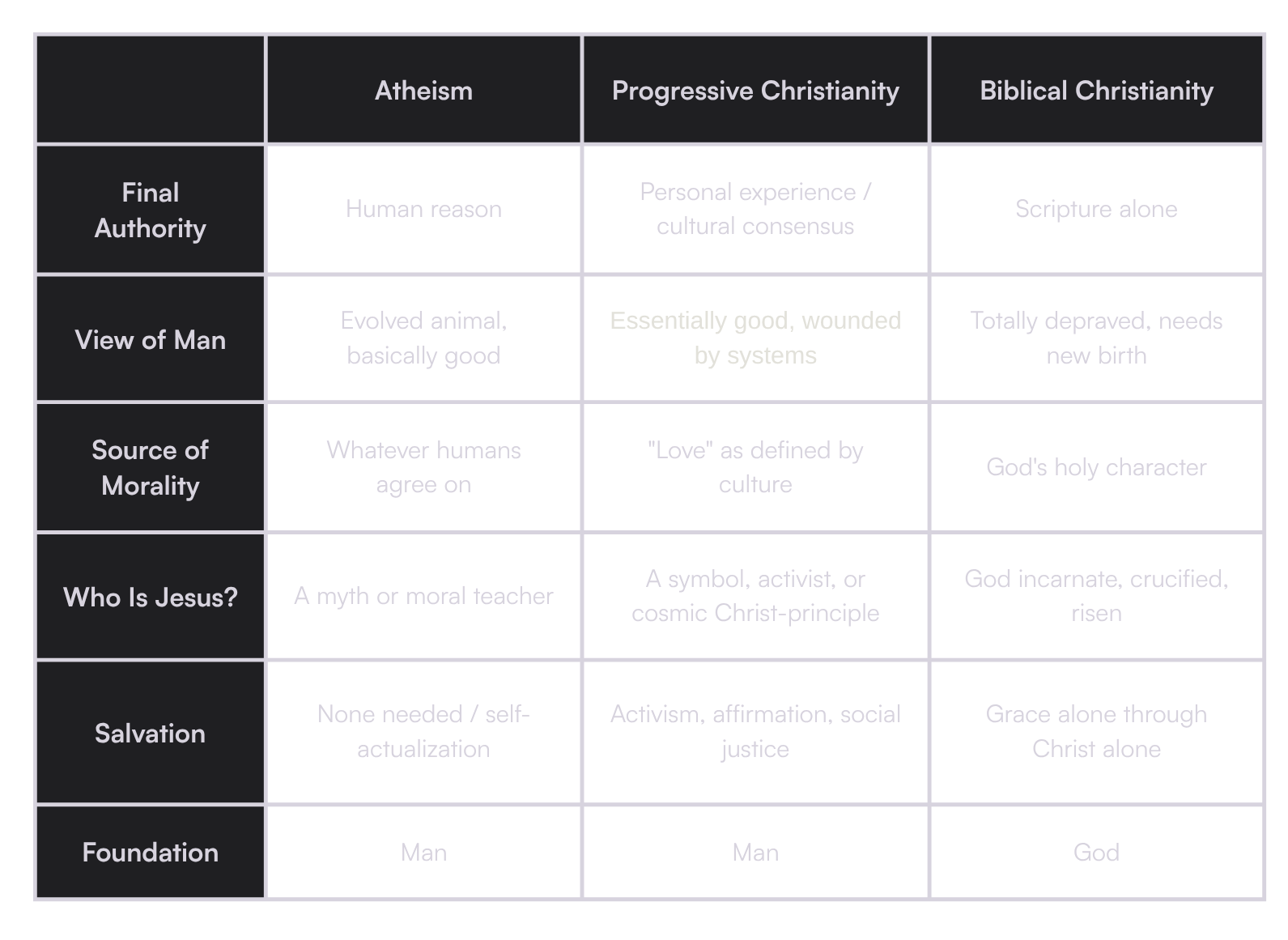
Side by Side
Two “man’s” and one “God.” That is the whole article in a single row. The costumes are different. The foundation is identical. Biblical Christianity is the only worldview in the room not built out of human material.
Kill the Root
Most Christians, when they meet an atheist, grab The Case for Christ and argue historical evidence. When they meet a progressive Christian, they walk through how “Jesus has given us grace in the church age.”
Stop it.
You are not going to win by arguing evolution with an atheist who has already decided God isn’t allowed at the table. You are not going to win by quoting Leviticus and explaining Biblical law to a progressive who has already decided her feelings outrank Scripture.
Because in both cases, the foundation is the same. Man is the judge. Man is the authority. Man decides what counts as evidence, valid Scripture, and a reasonable argument. As long as that foundation is intact, you are playing a game rigged against you.
You have to go lower. Under the debate. Under the specific doctrine. Kill the root. The root is humanism. Man’s self-assumed authority over God.
The Move
So when the humanist shows up in one of his costumes, what do you actually say? You refuse to debate on his turf. You drag the conversation down to the foundation.
Ask him:
“What is your standard for truth?”
The atheist says science, reason, and evidence. Ask him: Where did the laws of logic come from? Why trust human reason in a universe produced, on his own view, by a mindless process with no interest in producing true beliefs? He is standing on man.
The progressive Christian says love, Jesus, her experience of God. Ask her: whose definition of love? Whose Jesus? Why does your experience outrank Scripture? She decides. She is standing on man.
Then say:
“I am not standing on man. I am standing on the God who made man. The difference between us is not that I’m smarter or more moral. The difference is that I stopped trying to be my own god and bowed the knee to the real One.”
Stop trying to convince the unbeliever from his own assumptions. Show him his assumptions cannot stand without borrowing from yours. Show him he is using God’s air to argue against God, God’s logic to disprove God, God’s morality to judge God.
Then hand him the gospel.
R.J. Rushdoony, The Religion of Fallen Man — Chalcedon Foundation
R.J. Rushdoony, Humanism and Change — Chalcedon Foundation
R.J. Rushdoony, The Religion of Fallen Man — Chalcedon Foundation↩︎